The Hang Power Clean vs. the Bridge in Grappling: Can Gym Strength Transfer to the Mats?


In grappling sports such as Brazilian Jiu-Jitsu, wrestling, and submission grappling, explosive power can be the difference between escaping a bad position and getting submitted. While technical skill always comes first, strength and conditioning play a major role in helping athletes express technique under pressure. One movement often used in strength programmes for combat athletes is the Hang Power Clean (HPC). Coaches frequently prescribe it to develop explosive triple extension, power output, and athleticism. But does the HPC actually transfer to grappling performance? More specifically, does it dynamically correspond to one of grappling’s most important escape movements: the Bridge? We explored exactly this question using the framework of Dynamic Correspondence (DC), a theory developed by Yuri Verkhoshansky and Mel Siff to determine how closely a gym exercise matches a sporting action.
Understanding the Bridge in Grappling
Before comparing the movements, it is important to understand what the Bridge actually is. In grappling, athletes constantly fight for dominant positioning. One of the worst places to be is mounted on the bottom, where an opponent sits on top of the torso and controls movement with bodyweight and hip pressure.
From this position, grapplers commonly attempt three escapes:
Shrimping (lateral hip movement)
Turning to the knees
Bridging or “hip bumping”
The Bridge is a highly explosive movement. The athlete drives their feet into the floor, rapidly extending the ankles, knees, and hips to elevate the opponent and create space. Simultaneously, the arms assist by pushing against the opponent’s hips or torso. Once enough space is created, the athlete quickly repositions the legs to recover guard or escape. Biomechanically, the Bridge is a rapid triple extension movement performed while lying supine. That triple extension pattern immediately raises comparisons with Olympic lifting derivatives such as the Hang Power Clean.

What Is Dynamic Correspondence?
Dynamic Correspondence is a framework used to evaluate how well a training exercise transfers to sporting performance. Rather than asking whether two movements “look” similar, DC examines deeper biomechanical and physiological qualities. The more closely an exercise matches a sporting movement across these categories, the more likely it is to transfer effectively (Verkhoshansky & Siff, 2009).
Verkhoshansky and Siff, the ‘Godfathers’ of DC proposed five criteria:
Amplitude and direction of movement
Region of accentuated force production
Dynamics of the effort
Rate and time of maximal force production
Regime of muscular work
Why the Hang Power Clean?
The Hang Power Clean is a simplified Olympic lifting derivative that starts from the “hang” position, with the bar held above the knees. From there, the athlete explosively extends the hips, knees, and ankles (the classic triple extension pattern) to accelerate the bar upward before catching it in a partial squat. Compared with full Olympic lifts, the HPC can be easier to learn, less technically demanding, highly effective for developing power and may be an excellent option for improving rate of force development (RFD).
Research has consistently shown that Olympic lifting derivatives improve explosive athletic qualities such as sprinting, jumping, and rapid force production (Hori et al., 2005; Suchomel et al., 2015). The HPC has also been shown to improve peak power in novice lifters and athletic populations (Haug et al., 2015; Hori et al., 2008). Since grappling also requires explosive power production, especially during escapes and scrambles, the HPC appears to be a logical exercise choice, but does it truly match the Bridge?

Criterion 1: Amplitude and Direction of Movement
The first DC criterion examines joint angles, range of motion, and movement direction. At a glance, the Bridge and the Hang Power Clean look surprisingly similar, both involve initial flexion at the hips, knees, and ankles, explosive triple extension, rapid re-bending phase afterward. In the Bridge, the athlete flexes the lower body before explosively extending to elevate the opponent. In the HPC, the athlete transitions through a loaded hinge position before violently extending to propel the bar upward.
The comparison becomes even more interesting during the explosive phase. Lower limb joint angles during triple extension in the Bridge closely resemble those seen during the second pull of the HPC (Gourgoulis et al., 2000). However, the movements are not identical. The biggest differences include the Bridge occuring lying on the back, while the HPC is performed standing upright, the Bridge moving force horizontally relative to the body, while the HPC is more vertically oriented, and the Bridge often using a greater range of knee flexion. Despite this, the relative direction of force production may matter more than the absolute direction. Fitzpatrick and colleagues (2019) argued that the direction of force relative to the athlete may be more important than global force direction when considering transfer between exercises. So while the positions differ, the underlying mechanics share meaningful similarities.

Criterion 2: Region of Accentuated Force Production
This criterion focuses on where in the movement the highest force is produced. For an exercise to transfer well, peak force production should occur at similar joint angles and movement phases as the sporting skill. During the Hang Power Clean, peak force is produced during the second pull — the explosive extension phase where the athlete violently drives through the hips and knees (Kawamori et al., 2006; Suchomel et al., 2017). Interestingly, the Bridge also produces peak force during explosive hip extension. Although the exact knee angles differ between the two movements, both generate their highest force outputs during rapid triple extension. Maximum acceleration and velocity also occur during these explosive phases. In practical terms, this means both movements train the athlete to rapidly generate force through the posterior chain at the moment it matters most. That overlap is significant for grapplers, particularly when attempting explosive escapes against resistance.


Criterion 3: Dynamics of the Effort
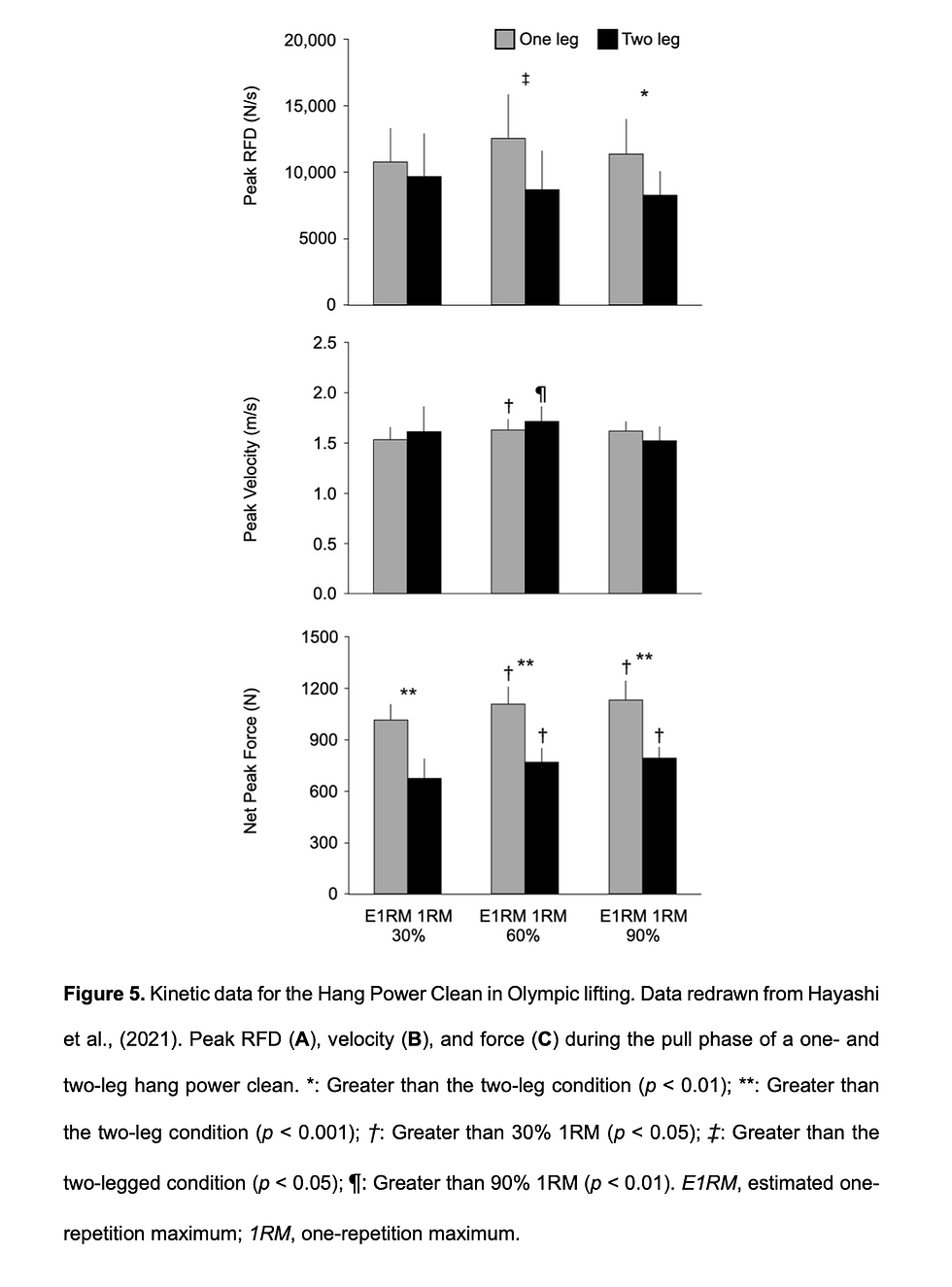
This may be where the strongest connection exists. Both the Bridge and the Hang Power Clean are ballistic, explosive movements that demand high rates of force development. The goal in the Bridge is simple, generate as much force as possible, as quickly as possible, to disrupt the opponent’s balance and create space. The HPC trains a nearly identical quality. Athletes must apply force rapidly to accelerate the bar before gravity slows it down. Research comparing force and velocity characteristics demonstrates strong similarities in the explosive nature of the two movements (Hayashi et al., 2021).
Importantly, the intent behind the movement matters. Research consistently shows that moving explosively with maximal intent produces greater athletic transfer than simply completing repetitions without speed or aggression (Kawamori & Newton, 2006; Padulo et al., 2012). For grapplers, this has major implications. A HPC performed slowly or mechanically may not provide the same transfer as one executed with maximal explosive intent. The quality of movement matters as much as the exercise selection itself.
Criterion 4: Rate and Time of Maximal Force Production
Combat sports are highly time-sensitive. An escape that occurs half a second too late may fail entirely. This is why rate of force development (RFD) is so important. Athletes must produce force rapidly, not just produce high force eventually.
From our internal data collection, time to peak force in the HPC and the Bridge were remarkably similar:
HPC: approximately 205–270 milliseconds
Bridge: approximately 215–237 milliseconds
That overlap is important because it suggests the nervous system demands are comparable (Suchomel & Sole, 2017).
Both movements also sit toward the “speed-strength” end of the force-velocity curve, prioritising rapid force production over slow maximal strength work, which suggests RFD can be improved through heavy resistance training, ballistic training, moving lighter loads explosively and/or combining strength and plyometric methods (Aagaard et al., 2001; Maffiuletti et al., 2016) which may have a positibve impact on explosive escapes, scrambling ability, takedown penetration, transitional movement and hip drive in grappling.
Criterion 5: Regime of Muscular Work
The final criterion looks at the type of muscular contraction involved. Both the Bridge and the HPC rely heavily on explosive concentric contractions of the posterior chain, including the glutes, hamstrings and spinal erectors. Both movements also involve coordinated extension of the hips, knees, and ankles. However, one key difference exists, the HPC includes a catch phase, where the athlete absorbs force eccentrically while receiving the bar. The Bridge does not contain this same eccentric loading demand. Additionally, neither movement strongly relies on the stretch-shortening cycle in the way sprinting or jumping does. Despite these differences, the overall muscular demands remain relatively similar, especially during the explosive phase.
So, Does the Hang Power Clean Transfer to Grappling?
The short answer is yes, the longer answer only partially.
The HPC demonstrates what is called “secondary dynamic correspondence” with the Bridge. This means the movement does not perfectly replicate the sporting skill, but it shares enough biomechanical and physiological characteristics to likely improve relevant athletic qualities.
The strongest similarities include:
Explosive triple extension
Rapid force production
Posterior chain involvement
Ballistic movement intent
Comparable timing of peak force output
The biggest differences include:
Body position
Direction of movement
Joint angle differences
The catch phase of the HPC
In other words, the HPC is not a direct replacement for grappling practice or sport-specific drills. But it may be one of the most useful Olympic lifting variations for developing explosive qualities relevant to grappling.
The Hip Thrust Debate
Interestingly, the article suggests that the barbell hip thrust may actually correspond even more closely to the Bridge than the HPC because the hip thrust is performed in a supine position, directly emphasizes horizontal hip extension, targets the posterior chain heavily and more closely resembles the body position of the Bridge.
Research has shown that hip thrusts can improve glute strength, power, and hypertrophy (Contreras et al., 2011; Contreras et al., 2015). Ballistic hip thrust variations may therefore offer excellent transfer to grappling-specific explosive movements. Rather than choosing one exercise exclusively, the author suggests that combining HPCs with hip thrusts may provide the best overall training effect.
Practical Takeaways for Grapplers
For coaches and athletes, the key lesson is that exercise selection should be based on transfer, not tradition. The Hang Power Clean appears valuable because it develops explosive force production qualities that are highly relevant to grappling. However, it should be part of a broader programme rather than treated as a magic bullet.
A well-designed grappling strength programme should likely include:
Heavy strength work
Ballistic power training
Olympic lifting derivatives
Hip-dominant exercises
Plyometric movements
Sport-specific drilling
Research consistently supports combining heavy and explosive training methods to maximise athletic development (Baker, 1996; Harris et al., 2000; Newton & Kraemer, 1994). Most importantly, exercises should be performed with maximal intent and appropriate loading. In grappling, the ability to bridge hard, fast, and violently may be the difference between escaping mount and losing the match.

References
Aagaard, P. et al. (2001). Journal of Physiology, 534, 613–623.
Baker, D. (1996). Journal of Strength and Conditioning Research, 10, 131–136.
Contreras, B., Cronin, J., & Schoenfeld, B. (2011). Strength and Conditioning Journal, 33, 58–61.
Contreras, B. et al. (2015). Journal of Applied Biomechanics, 31, 452–458.
Fitzpatrick, D. A. et al. (2019). Sports, 7, 30.
Gourgoulis, V. et al. (2000). Journal of Sports Sciences, 18, 643–652.
Harris, G. R. et al. (2000). Journal of Strength and Conditioning Research, 14, 14–20.
Haug, W. B. et al. (2015). Journal of Strength and Conditioning Research, 29, 1766–1779.
Hayashi, R. et al. (2021). Research on HPC force and velocity characteristics.
Hori, N. et al. (2005). Strength and Conditioning Journal, 27, 50–55.
Hori, N. et al. (2008). Journal of Strength and Conditioning Research, 22, 412–418.
Kawamori, N. & Newton, R. U. (2006). Strength and Conditioning Journal, 28, 86.
Kawamori, N. et al. (2006). Journal of Strength and Conditioning Research, 20, 483–491.
Maffiuletti, N. A. et al. (2016). European Journal of Applied Physiology, 116, 1091–1116.
Newton, R. U. & Kraemer, W. J. (1994). Strength and Conditioning Journal, 16, 20–31.
Padulo, J. et al. (2012). International Journal of Sports Medicine, 33, 376–380.
Suchomel, T. J. & Sole, C. J. (2017). Journal of Sports Science & Medicine, 16, 407–413.
Suchomel, T. J. et al. (2015). Sports Medicine, 45, 823–839.
Suchomel, T. J. et al. (2017). Journal of Strength and Conditioning Research, 31, 1644–1652.
Verkhoshansky, Y. & Siff, M. (2009). Supertraining (6th ed.). Self-published.


Comments