From Paper to Podium: Evaluating the Translational Potential of Performance Nutrition Research


Sports Science is one of the most extensively researched areas within performance, yet it is also one of the most inconsistently researched in elite sport. Despite a large and growing body of peer-reviewed literature, the translation of research findings into meaningful changes in athlete behaviour and performance outcomes often lags behind scientific discovery. The gap between controlled laboratory studies and real-world application is a persistent issue in applied sport science. This disconnect is particularly evident in elite sport environments, where decisions must be made rapidly, under pressure, and within the constraints of travel, scheduling, individual athlete preferences, and organisational culture.
From Controlled Studies to Chaotic Environments
Most performance nutrition studies are conducted in tightly controlled laboratory environments. These studies typically involve: homogenous participant groups (often recreational or university athletes), standardised diets and training protocols, short intervention durations and highly controlled environmental conditions. While this approach improves internal validity, it limits ecological validity. Elite sport, by contrast, is characterised by irregular schedules, often high travel load, psychological stress, inter-individual variability, concurrent training demands and competition-driven periodisation. As a result, interventions that appear effective in the lab may be difficult to implement in elite environments.
Close et al. (2019) highlighted this mismatch as a core issue in translational failure.
The Hierarchy of Evidence vs. Applied Value
A key theme in Close's evaluation is that traditional hierarchies of evidence do not always align with applied usefulness. For example, randomised controlled trials (RCTs) are considered gold standard, however they often lack contextual realism for elite athletes, and case studies, while lower in hierarchy, may provide richer applied insight In performance nutrition, this creates a trade off between scientific rigour, practical feasibility and athlete adherence. An intervention that is 'statistically significant' in a lab may still fail in practice due to logistical / applied barriers.
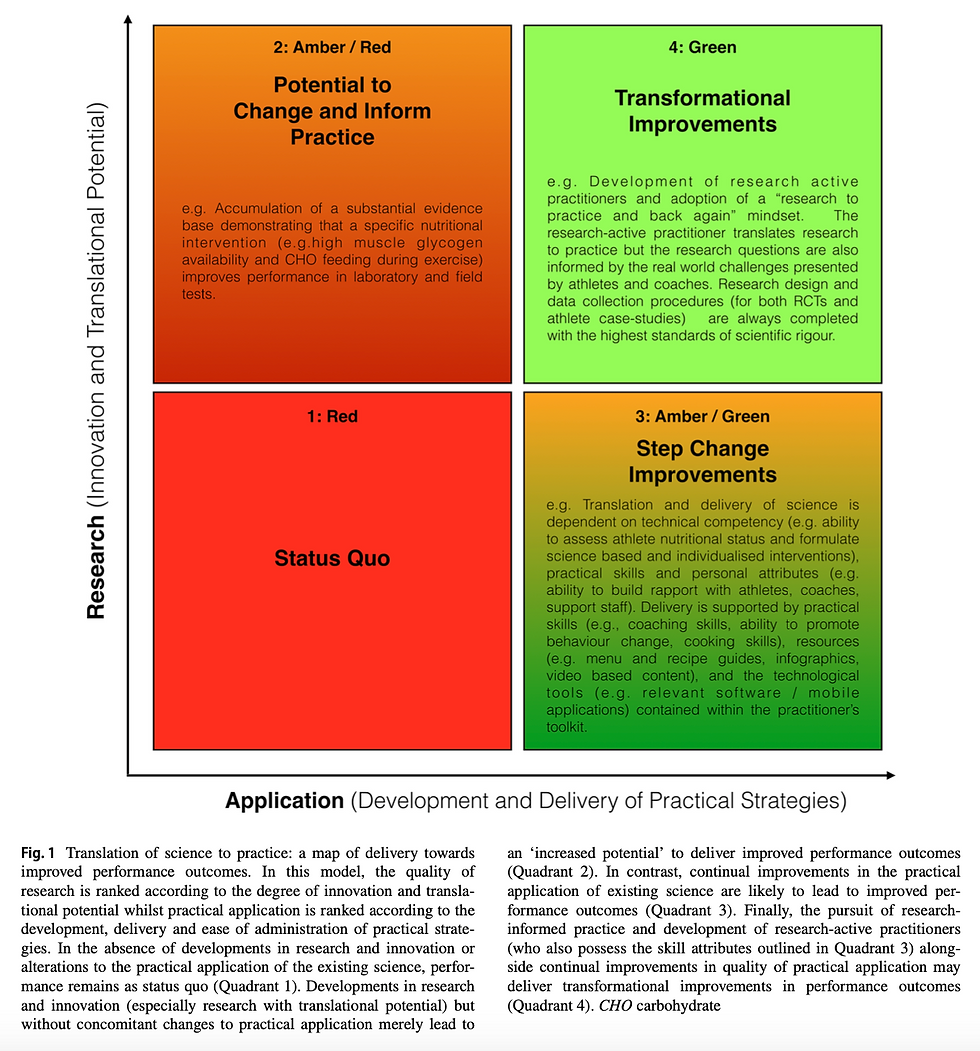
Barriers to Translating the Science
Ecological Validity
One of the most significant barriers is ecological validity (the extent to which findings reflect real-world conditions). For example, controlled carbohydrate loading protocols or strength diagnostic assessment may not account for issues in the applied setting such as travel fatigue and hydration or resistance training inerventions may not consider match scheduling or access to fluids, equipment, space, facility etc. Close et al. (2019) argues that without ecological alignment, even strong evidence may have limited practical impact.
Improving translation begins with better research design. This involves using elite athlete populations where possible, conducting field-based studies in real training environments, incorporating competition schedules and allowing for individualisation within protocols. The closer research resembles reality, the more applicable it may become.
Athlete Compliance and Behaviour
Even well-supported interventions are only effective if athletes adhere to them.
Compliance is influenced by taste and palatability, convenience and timing, cultural preferences, tolerance, sychological beliefs, social influences. Within teams, especially within elite environments, athletes are not passive recipients of sport science plans, they are becming aincreasingly active decision-makers and if a strategy is perceived as inconvenient or uncomfortable, adherence drops rapidly.
Timing of Research Outputs
A recurring issue is the delay between discovery and application.
By the time research is peer reviewed, published, synthesised into reviews and applied to practice / integrated into guidelines, it may already be outdated relative to evolving sport demands. Elite sport evolves quickly, particularly in areas such as match intensity, fixture congestion, travel demands and as such, this creates a lag between science and practice.
Individual Variability
Athletes respond differently to identical intervention strategies for a number of reasons, including genetics, training status, gut tolerance, metabolic flexibility and psychological preferences. Close et al. (2019) emphasises that 'average responses' reported in studies often fail to represent individual responses in elite populations. This is particularly relevant for strategies such a caffeine dosing, where tolerance levels and perceived effect vary drastically between individuals. What works for a group may not work for a specific athlete in their individual circumstance.
Practical Constraints in Elite Sport
Elite sport environments impose constraints rarely reflected in research. Examples of this is the mixed meal provision available (training ground catering differences), limited cooking autonomy during travel and limited control over strength and conditioning equipment available. Even a highly effective intervention may be impractical if it cannot be delivered within the operational structure of a team.
The Role of Applied Sport Scientists: Translators, Not Just Researchers
A central argument in Close et al. (2019) is that sport scientists must function as translators, not simply consumers or producers of research. This requires researchers / practitioners to interpret evidence in context, to simplify complex findings for athletes and coaches, to adapt interventions to constraints and to prioritise feasibility alongside efficacy. In practice, this often means moving away from 'optimal' strategies and toward 'robust' strategies and interventions that are imperfect in theory but consistently effective in the reality of elite sport.
Bridging the Gap: Strategies for Better Translation of Research into Practice
Ecologically Valid Research Design
Improving translation begins with improved research design. This involves using elite athlete populations where possible, conducting field-based studies in real training environments, incorporating competition schedules and allowing for individualisation within protocols. The closer research resembles reality, the more applicable it may become.
Mixed-Methods Approaches
Quantitative data alone may not capture the full complexity of intervention behaviours and intervention success. Qualitative interviews, practitioner observations, case study analysis and tracking of behaviours away from the club allows researchers to understand not just what interventions works, but why these work or fail in practice.
Simplification of Messaging
Complex scientific findings often fail in translation due to poor communication ability. Effective applied strategies need to be clear, actionable, easy to understand and implement and simple to integrate into existing routines.
Individualised Approach
A key applied advancement is the shift toward individualisation is to target specific interventions dependent on a number of individual factors rather than applying uniform protocols. This aligns with the reality that athletes respond differently under stress and competition conditions within their own individual situations.
Integration with Coaching and Performance Staff
Sports science interventions cannot exist in isolation. Successful translation requires integration with strength and conditioning coaches, medical teams, psychologists and technical staff. Without interdisciplinary alignment, even strong intervention strategies may fail.
Moving From Paper to Podium
Close et al. (2019) frames the goal of performance interventions as measurable improvement in competition outcomes, not just physiological markers and p values. To achieve this, translation must be context specific, athlete-centred, flexible and evidence informed rather than evidence dictated. As such, Close et al. (2019) came up with a framework for assessing research (specifically centred around nutrition, however may be applied to the wider sports science research) and its ability to be taken and applied into the elite sporting environment. As such, they came up with an 8 criteria scoring system for easy assessment of research intervention.


Conclusion
The translational gap between lab based research and performance remains one of the most important challenges in applied sport science. While the scientific literature continues to expand, its real-world impact depends on how effectively findings are adapted to the constraints and realities of elite sport. Close et al. (2019) highlights that success in performance nutrition is not determined solely by the strength of evidence, but by the ability to translate that evidence into actionable, sustainable, and individualised strategies that athletes can and will actually follow. Ultimately, the difference between paper and podium is not just knowledge, it is execution under the specific constraints present.
References
Burke, L. M., et al. (2011). Journal of Sports Sciences, 29, S17–S27.
Close, G. L., et al. (2019). International Journal of Sport Nutrition and Exercise Metabolism, 29, 317–325.
Jeukendrup, A. E. (2017). Sports Medicine, 47, 51–63.
Maughan, R. J., & Burke, L. M. (2012). Journal of Sports Sciences, 30, S1–S3.
Morton, J. P., et al. (2018). Sports Medicine, 48, 1–6.
Phillips, S. M., & Van Loon, L. J. C. (2011). Journal of Sports Sciences, 29, S29–S38.
Thomas, D. T., et al. (2016). Journal of the Academy of Nutrition and Dietetics, 116, 501–528.


Comments